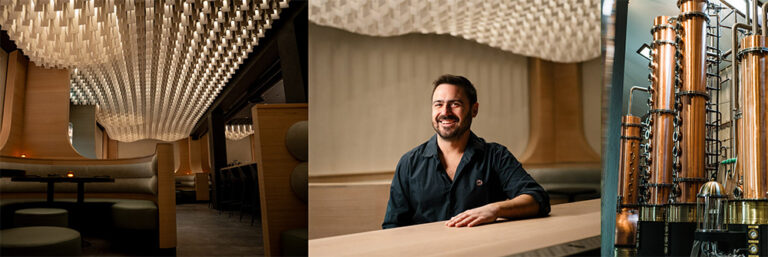
Rupert Michell spent his twenties chasing snow — ski instructing his way through Japan, the U.S., and Canada — before the mountains and rivers around Golden made him stop moving. He enrolled in the adventure tourism program at College of the Rockies to make it official, and by the time he finished, he knew he wasn’t leaving.
He wasn’t a distiller. He wasn’t even, on paper, a hospitality guy — a stint managing a bar in Japan was as close as it came. But he’d watched Whitetooth Brewing open in Golden and take off, and it planted a question he couldn’t shake: what else could this town support that it didn’t have yet?
For Rupert, the answer was the Stolen Bell — Golden’s first craft distillery. And once he’d decided, he refused to guess his way there. Before Stolen Bell was a business plan, it was a road trip and an in dept intentional research. Rupert spent months driving across BC, walking into nearly every distillery in the province, taking notes on what worked, what didn’t, and what he’d wish he’d known earlier. He came home with a notebook full of answers and a business plan built from day one to scale.
An Opportunity Worth Building
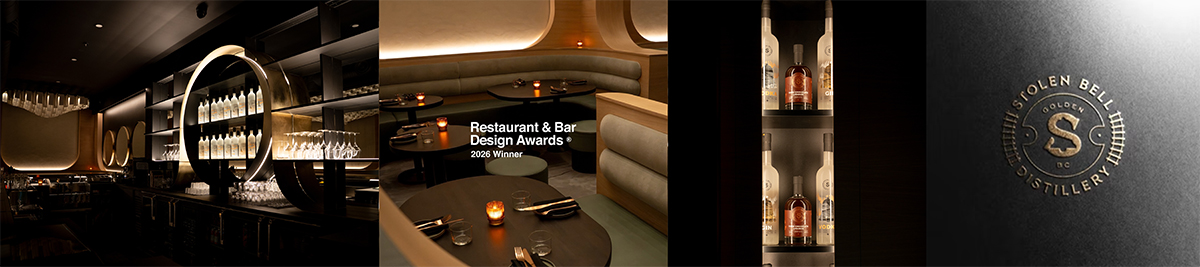
Golden didn’t have a craft distillery. Rupert saw that as a chance to bring something entirely new to a town he already loved, built the way he wanted it built: local, from the ground up. The name comes from a local fable — the bell at Golden’s St. Paul’s Anglican Church, stolen and returned more than once in the town’s frontier days — and the brand carries that history through to the smallest details. The logo cuts a bell into the negative space of the “S,” framed by railroad tracks; the retail bottles are frosted everywhere except for that same bell shape, clear enough to reveal a mountain scene printed on the inside. It’s a sleek, modern identity built from a century-old story — which is, in miniature, exactly what Stolen Bell is doing with the whole town.
Everything about the build stayed close to home. The grain comes from just down the road in Edgewater. The still was sourced in BC. The carpenters, plumbers, and contractors who built the space are Rupert’s friends and neighbours — the only outside trades brought in were for steam piping and fire suppression, specialty work out of Alberta. During development, Rupert ran Friday tasting sessions with friends from the community, shaping the final product lineup around their feedback. Other local business owners offered guidance along the way and became partners after the launch.
“I’ve always seen this town as the town of opportunity. It’s a small, growing community, but if you have a great idea, you can make it happen here.”
— Rupert Michell, Founder & CEO
A Team That Was Already Here
Every one of Stolen Bell’s 15–20 staff was already living in Golden when they were hired — no recruiting trips, no relocation packages.
“Golden is really good at being inclusive in what you do. You don’t have to be the best at it — as long as you participate, you’re part of it,” Chef Jorrit says. He found that first through Golden’s run club, and it’s the same thing he sees now in his own kitchen: people who came for the mountains, and stayed because the community made room for them.
The Kitchen That Grew Alongside the Still
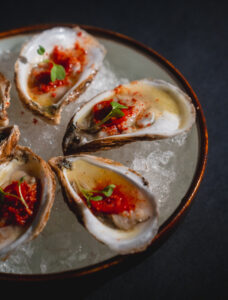
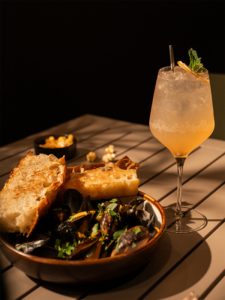
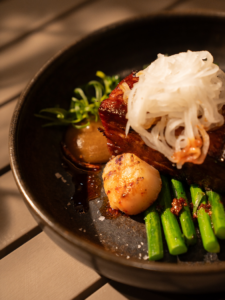
Stolen Bell’s restaurant has become as much a part of its story as the spirits. Jorrit built the menu around dishes that feel familiar with an unexpected twist — Indian-spiced chicken tenders, a gochujang carbonara, a Chinese-style braised pork belly — and around ingredients sourced as close to home as possible. Ethos Bakery supplies the focaccia, baguettes, and rye bread. Golden Acre Farms supplies the pork — pasture-raised pigs whose feed comes, in part, from the distillery’s own spent grain.
That partnership produced one of the kitchen’s best stories. A limited-run feature made from a Golden Acre Farms pig — steamed pork dumplings — sold so well over the winter that it became a permanent menu item.
That’s exactly where Golden’s tight-knit business community shows up: growers, bakers, and farmers working out pricing and supply together, one relationship at a time, so a small-town kitchen can keep sourcing hyper-local without losing the numbers. It’s slower than ordering from a distributor — but it’s how a dish like the dumplings gets made at all.
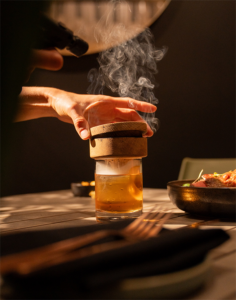
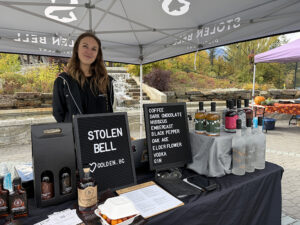
The menu is built to pair with what’s happening on the still. The dumplings share a table well with Lilo — a vodka cocktail built on lychee, cold-brew jasmine, and a hibiscus-dragonfruit foam — while the dark chocolate liqueur, Rupert’s personal favourite, shows up in cocktails built for the evening’s close. The result is what Jorrit calls an elevated dining experience without being fancy — the kind of place where a table in ski gear sits next to a table dressed for a night out, and both belong. It’s also, increasingly, a reason people plan return trips to Golden: for the pairings between food and spirits, for live music nights, for an evening that didn’t exist in town 1 year ago.
An Award-Winning Space
Stolen Bell Distillery has been named the 2026 Restaurant & Bar Design Awards Winner for Surface Interiors in The Americas.
The look of the place was never an afterthought. Stolen Bell’s still house and cocktail lounge were designed to feel sleek and modern — a sharp contrast to the main street around it — and that work has now won international recognition. Stolen Bell Distillery has been named the 2026 Restaurant & Bar Design Awards Winner for Surface Interiors in The Americas, out of 1,155 entries from 73 countries across 53 categories. It was also shortlisted in a second category, In Another Space, which honours venues that blend multiple functions — in Stolen Bell’s case, a working distillery, a cocktail lounge, and a kitchen — into one cohesive space, and it was the only Canadian venue shortlisted in both. For a distillery on a Golden side street, it’s the kind of win that puts a small-town brand in front of travellers, buyers, and partners far beyond the Trench.
Built to Scale
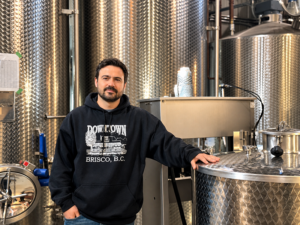
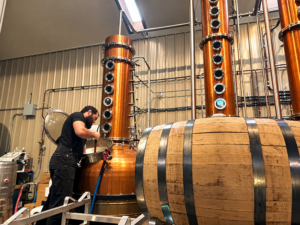
Stolen Bell runs a 1,000-litre still — larger than most craft distilleries in BC — alongside two 3,000-litre fermenters currently running at half capacity, with plenty of room to grow. Production sits at roughly 700 litres of vodka every two weeks, with capacity to double as distribution expands. A whiskey program is already aging quietly in the background: 12 barrels in year one, 12 more in year two.
“There’s no reason we should be buying American or Russian vodka. We should be producing it locally and distributing it locally.”
— Rupert Michell, Founder & CEO
The Opening Behind the Opening
Stolen Bell’s growth doesn’t stop at its own storefront — it creates demand for businesses Golden doesn’t fully have yet. A distillery this size needs grain at scale, and right now BC’s craft producers still lean on a small handful of regional maltsters; Kootenay West Distilling, down the valley in Trail, built its entire identity around a single dedicated grain supplier. Golden’s own growers, already supplying Stolen Bell’s kitchen out of Edgewater, are positioned to do the same at a larger scale. The same goes for the services that come with a growing distillery — bottling and labelling, barrel cooperage for the whiskey program, and regional distribution as Stolen Bell pushes into Alberta and the BC Interior.
Still Early Days
Stolen Bell is running at half capacity. The fermenters have room to double output, the whiskey program has two more vintages before its first release, and the expansion map — Golden, then the Trench, then Alberta and the Interior — is barely underway. None of it required outside capital, an imported workforce, or a market built from scratch. It required local grain, local trades, local staff, and a regional customer base already large enough to support it.
That’s the case Golden keeps making, one business at a time: the inputs for a scalable operation are already here. Stolen Bell is what happens when someone puts them to work — a chef who found his kitchen the same way he found his run club, a farmer whose pigs became a signature dish, a founder who never planned on any of it and wouldn’t be anywhere else now.
“I don’t see myself anywhere else in this world.”
— Rupert Michell, Founder & CEO