Innovation & Sustainability
Sigi Liebmann arrived in Golden in the late 90s as a Swiss Master Timberframer hired to assist Canadian Timberframes in the set-up of CNC technology and staff training. He had built his career doing exactly that kind of work in Europe — 3D modeling, machine programming, design consultancy across Switzerland and beyond. He was also part of the team developing a stacked DLT (dowel laminated timber) product in the 1990s in Switzerland. The plan was simple: help the Golden company get up and running, then go home.
He never went home.
“Golden just felt like home right from the start. I grew up on a small farm in Switzerland — a town with a hundred inhabitants. So I like the small town feel.”
— Sigi Liebmann, Founder, International Timberframes
Golden had that. But it had something else too, something he hadn’t expected: a scale of opportunity that Switzerland, for all its craft tradition, couldn’t match.
The Specialist Effect
Back in Europe, Sigi had earned the highest level of training available in his trade — a higher technical school credential in wood engineering and professional timber expertise. It was a rigorous, years-long education. And in Switzerland, it made him one of many, since it is a common approach to do post-secondary training within the trades.
“[In Switzerland] you are not even a number. And then coming to Golden and BC, you realize with specialized schooling from Switzerland — you’re the specialist.”
— Sigi Liebmann
The difference wasn’t just professional recognition. It was the kind of work that followed. Projects like the Pedestrian Bridge in Golden, the Eagle Eye development, and the day lodge at Kicking Horse Mountain Resort — commissions of that scale and complexity were once-in-a-career opportunities overseas. In Golden, they were just the first few years.
In 2003, Sigi founded International Timberframes. He had spent four years workiing for Canadian Timberframes, after that he consulted a few other companies with the same CNC technology and staff training across BC and Alberta. In 2005 his passion brought him back to his timberframing roots and he started hand-crafting timberframe structures.
A Product Without Compromise
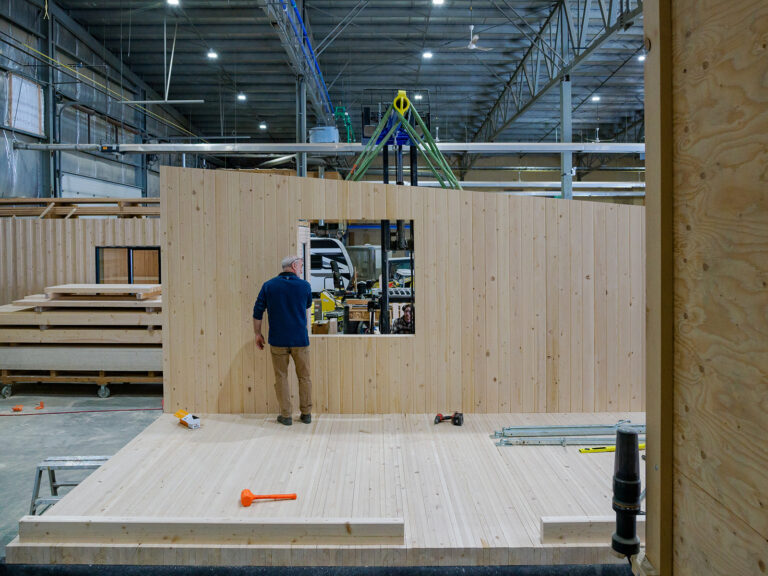
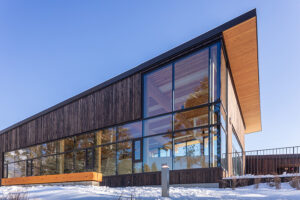
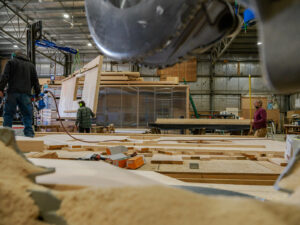
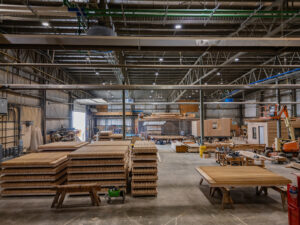
Currently International Timberframes works in two product ranges : traditional hand-cut timber frames, and Dowel Laminated Timber panels — structural floor, wall, ceiling, and roof systems built from solid BC wood pressed together using only hardwood dowels. No glue. No nails.
That distinction is not cosmetic. Most mass timber products on the market — cross-laminated timber (CLT), glue-laminated timber (glulam) — achieve their structural properties through adhesive bonding. International Timberframes doesn’t.
“We want to do the same thing, but completely glue-free. Because we truly care about the natural material. We don’t want to contaminate it with glue, or have any off-gassing for people or for the indoor climate.”
— Sigi Liebmann
The performance outcome surprises most people: without glue, ITF’s DLT actually achieves a higher R-value than its glued counterparts. Better for buildings. Better for the people in them.
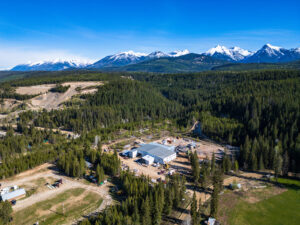
The company manufactures DLT panels in-house at their Donald facility using a prototype machine purpose-built in Revelstoke, BC. That means complete quality control from raw lumber to finished structural panel, faster lead times, and a shorter supply chain. ITF also supplies DLT billets to secondary manufacturers, making them both a regional producer and an end-to-end builder depending on what a project requires.
ITF’s projects have been featured in Mountain Living magazine and covered by America by Design, a US television series on architecture. The company now ships across North America.